Blog Archive

Saturday, November 13, 2010

3rd, 4th, and 5th graders Draw from Bones and Shells

Bones and shells are the evidence of the life of an animal.  Handling and looking at these objects requires respect and great care.  In addition, it offers students a chance to discover small details that they usually wouldn't have the opportunity to see.
 In this lesson, students learn that even an object as complicated as a skull or a shell can be translated into related shapes that make up the whole object.  The trickiest part is to translate all that we notice from these curved and textured 3D objects into a drawing on a flat piece of paper.
We discussed how to measure and map the distances between major shapes.

Then we talked about how to draw in the details that we saw.


Thursday, November 11, 2010

3rd, 4th, and 5th grades Make Observational Drawings of Animals!

Animals hold a great fascination for most children. In a previous lesson, students painted animals from their imagination.  Sometimes memory fails us, and it is difficult to think of the nuances that make up animals.  This can be extremely frustrating for any artist.  In order to nurture confidence and ability, in this lesson we looked closely at (plastic) animals to observe the differences between many different kinds of animals.  Then, we translated our findings into detailed drawings.


How does our perspective change what we can see?

What are the parts of your animal that make it unique?
What is the shape of the nose?
... of the feet?

Do you notice the curve of your animal's back?
Where is the fin: is it closer to the front or to the middle of your animal's back? 

How can you use your pencil to add texture?


Wednesday, November 10, 2010

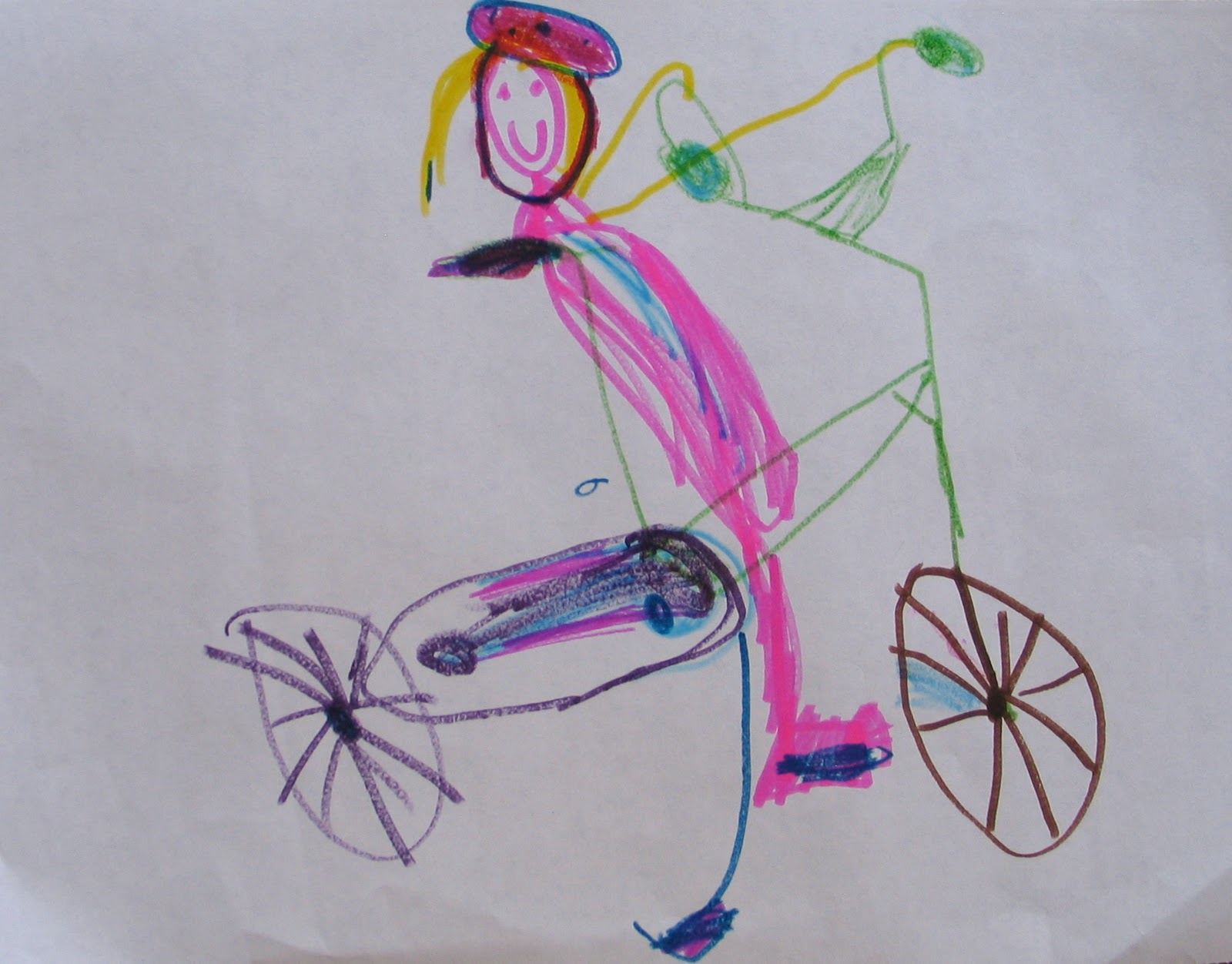
K, 1st and 2nd grade Make Observation Drawings of Bicycles.

Look closely: what shapes do you see?
Where do you notice circles?
...Triangles?
...Other shapes?

How will you put all the shapes together to build a drawing of this bicycle?
Where do the shapes connect?
Where will you add details?

How will you make the shapes that you see stand out?
Will you use your imagination to add color?


Will you use your imagination to make up a background story for your bicycle?


Will you draw a person on your bicycle?

"I drew the front tire circle too flat, so I decided to make it into a flat tire.  The tack is in the tire."

"I drew the tires too flat, so I made them melting in hot lava."


Tuesday, November 9, 2010

...by the way... take a look at our color wheel!

How do our students mix and paint such a wonderful array of colors?  They mix the colors they want themselves!

This is our color wheel is a work in progress.  As students mix a new color, they make a color chip... we then put in onto our color wheel as a class.  We talk about how the color was made (we use math here).  We also use art vocabulary (shade, tint, hue, primary, secondary) so that art words become second nature to us.
Students only use the primary colors of red, yellow, and blue, as well as black (not pictured) and white.

Monday, November 8, 2010

K, 1st, and 2nd grades make Painted Shape Collage Animals and People. Building on their texture/shape collage experience, students discover how they can put shapes together to make a creature in an environment.

This post has many, many, many photos!! Scroll through the entire post and you won't be disappointed!
What shapes do you need to put together to make a person?

What special kinds of animals do you know about?  What special shapes do you need to put together to make that animal?


Where does your creature live?  What kind of background do you need to make to show that?

Do the cardboard shapes make you think of a specific type of creature?


How can you put shapes together to make a larger part of your animal?